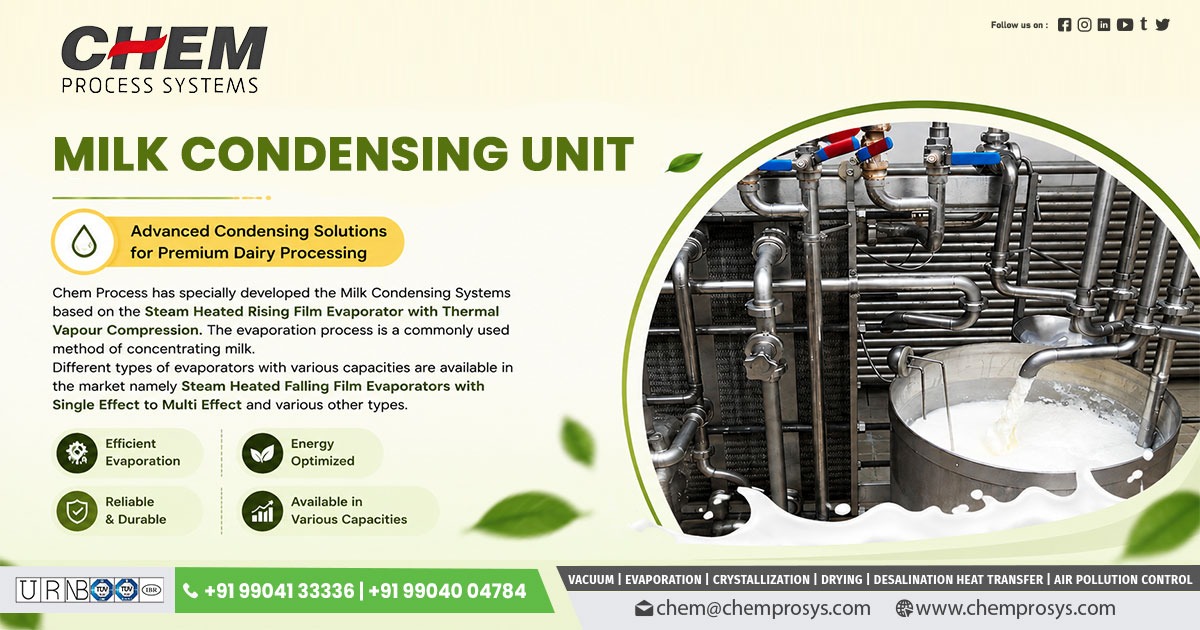
Milk concentration is an important process in the dairy industry. It reduces the water content of milk while retaining its valuable solids, flavour, and nutritional properties.
Chem Process Systems Pvt. Ltd. designs and manufactures efficient milk condensing systems based on steam-heated rising film evaporation with Thermal Vapour Compression (TVR).
Engineered for consistent performance and economical operation, these systems help dairy manufacturers improve product concentration, reduce steam consumption, and handle milk gently during evaporation.
Our registered office is located in Sanand, Gujarat, India.
Who Is Chem Process Systems Pvt. Ltd. and What Do They Offer?
Chem Process Systems Pvt. Ltd. is an experienced manufacturer and supplier of evaporation, concentration, and thermal-processing equipment for dairy and process industries.
The company offers:
- Steam-heated rising film evaporators.
- Thermal Vapour Compression systems.
- Single-effect and multi-effect evaporators.
- Falling film evaporation solutions.
- Energy-efficient milk concentration systems.
- Hygienic, food-grade process equipment.
- Automated controls for accurate operation.
- Installation and commissioning support.
- Maintenance and technical assistance.
We design each system according to the customer’s production capacity, feed characteristics, concentration requirements, available utilities, and plant layout.
What Are the Main Components of a Milk Condensing Unit?
A milk condensing unit generally includes the following components: Feed Balance Tank, Feed Pump, Preheater, Calandria or Heat Exchanger, Rising Film Evaporator, Vapour Separator, Thermal Vapour Recompressor, Condenser, Vacuum System, Condensate System, Product Discharge Pump, Control Panel, CIP System
How Does a Milk Condensing Unit Work?
The milk condensing process takes place in several controlled stages:
- Milk feeding: The system receives fresh or pretreated milk in the balance tank and pumps it into the system.
- Preheating: We gradually heat the milk using recovered process heat to improve overall energy efficiency.
- Film formation: Milk enters the evaporator tubes and forms a thin film along the heating surface.
- Evaporation under vacuum: Steam supplies heat while the vacuum reduces the boiling point. Water evaporates without exposing the milk to excessive temperatures.
- Vapour separation: The vapour separator removes generated water vapour from the concentrated milk.
- Thermal vapour compression: We recompress a portion of the vapour with motive steam and reuse it as a heating medium.
- Concentration control: The process continues until the milk reaches the required total-solids concentration.
- Product discharge: The concentrated milk is pumped to a storage tank or forwarded for drying, cooling, or further processing.
This controlled process helps reduce thermal damage while maintaining product quality and achieving dependable concentration.
Benefits of a Chem Process Milk Condensing Unit
- Efficient removal of water from milk.
- Lower steam consumption through vapour reuse.
- Gentle evaporation under vacuum.
- Reduced risk of heat damage.
- Consistent product concentration.
- Hygienic stainless-steel construction.
- Compact and practical plant configuration.
- Automated process monitoring.
- Easy cleaning and maintenance.
- Capacity and configuration tailored to the application.
Applications of Milk Condensing Unit
Milk condensing units are widely used for:
- Sweetened condensed milk production
- Unsweetened evaporated milk
- Concentrated whole milk
- Concentrated skimmed milk
- Milk powder plant feed preparation
- Infant formula processing
- Dairy whitener production
- Ice cream mix concentration
- Whey concentration
- Casein and dairy ingredient processing
- Flavoured and speciality milk products
- Reducing milk volume before transportation or storage
Frequently Asked Questions
Q1: Why is evaporation performed under vacuum?
A1: Vacuum lowers the boiling temperature, allowing milk to be concentrated gently while reducing heat-related changes in flavour and quality.
Q2: What is Thermal Vapour Compression?
A2: Thermal Vapour Compression reuses generated vapour as a heating medium, helping reduce fresh-steam consumption and improve energy efficiency.
Q3: Can the system be customized for different capacities?
A3: Yes. Chem Process Systems can customize the unit according to processing capacity, target concentration, operating conditions, and utility availability.
Q4: Which materials are used for milk-contact components?
A4: Product-contact components are generally manufactured from hygienic food-grade stainless steel selected according to dairy-processing requirements.
Partner with Chem Process Systems today for a reliable milk condensing unit tailored to your specific production needs.
Website: http://www.chemprosys.com
Email: chem@chemprosys.com
Phone: +91 99041 33337
View Product: Click here